-
-
23 percentage points — that was the gap in August 2026 between the share of battery electric vehicles (BEVs) in new passenger car registrations in the European Union and Poland. This disparity has never been greater.
-
The gap has widened as Poland commits to a project to build a hub in Jaworzno, whose success depends crucially on the domestic market.
-
Following New Mobility Congress 2026, PSNM presents ten recommendations aimed at strengthening Poland’s new mobility sector.
-
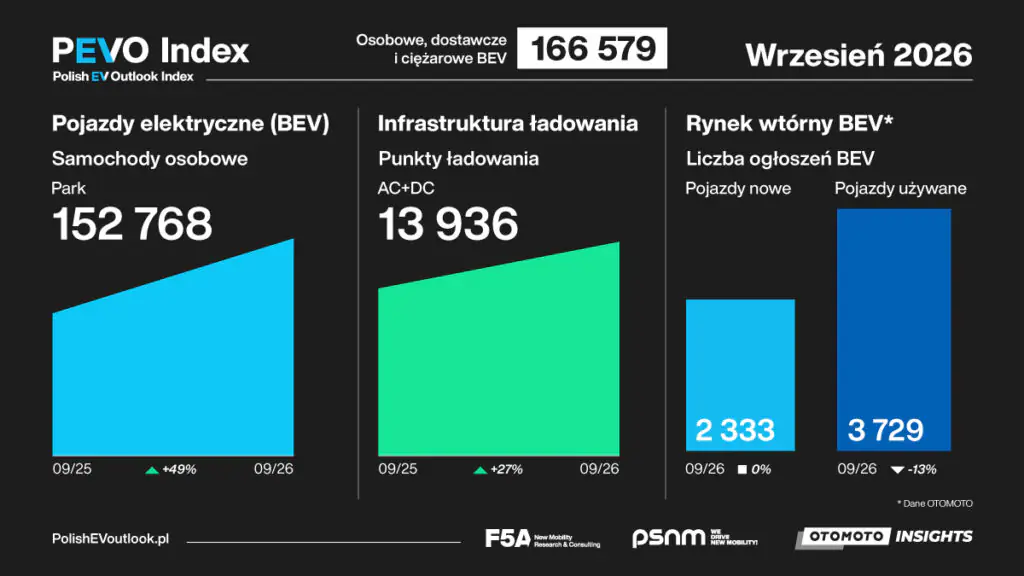
In August 2026, BEVs accounted for 27.7% of new passenger car registrations in the EU, compared with just 4.8% in Poland. From January to August, the respective shares were 21.7% and 5.1%; across the EU, EFTA and the United Kingdom combined, the figure reached 23.2%. Poland is the EU’s fifth-largest new car market, yet ranks 26th out of 27 member states in terms of BEV share. In the first eight months of the year, electric car registrations across the EU increased by 44.9% year on year. Poland, by contrast, recorded a 2.1% decline, making it the only EU country to report a decrease.
Poland is also falling behind markets in Southern and Central Europe. During the first eight months of the year, BEVs accounted for 10.2% of new car registrations in Spain, 8.1% in Italy, 7.0% in Czechia and 19.5% in Slovenia. Spain registered around four times as many electric cars as Poland, while Italy registered 4.4 times as many. The widening gap is particularly concerning given the government’s involvement in building a modern industrial base. An investment agreement between the National Fund for Environmental Protection and Water Management (NFOŚiGW) and ElectroMobility Poland secures PLN 4.5 billion in funding from Poland’s National Recovery and Resilience Plan for a production and development centre in Jaworzno. In PSNM’s view, an intervention of this scale should go hand in hand with a consistent policy supporting the electric vehicle market. The investment in ElectroMobility Poland represents an opportunity for the entire sector. Its potential should be strengthened by building a stable domestic market, developing Polish suppliers and advancing homegrown technologies. Without these measures, Poland risks increasing its industrial ambitions while allowing other countries to capture the benefits of the transition. Poland must avoid becoming a consumer of technologies that Europe is gradually moving away from. The Jaworzno hub is therefore a strategic investment, but its success in the initial phase will depend on demand generated in the domestic market. Current low electric vehicle registration figures fall far short of the conditions needed to make the project successful. Supporting measures are therefore essential now,” says Aleksander Rajch, Vice-President of PSNM.
The Polish Mobility Code and Compass 2035: The Next Steps After KNM
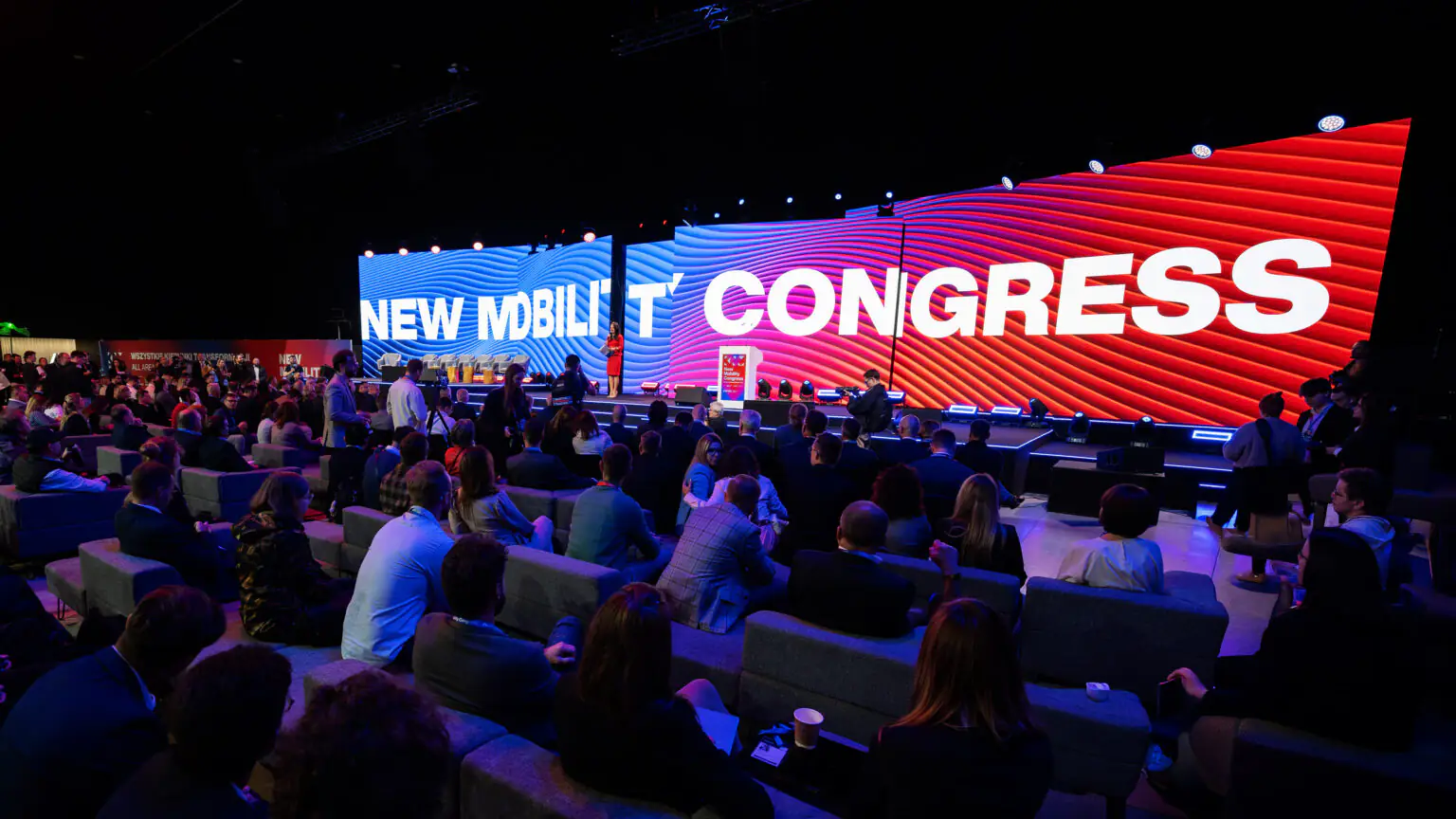
The 2026 New Mobility Congress in Katowice brought together nearly 10,000 participants. Discussions across 12 stages connected the automotive industry with energy, urban development and new technologies. The unveiling of affordable electric car models demonstrated that electromobility is becoming accessible to an increasingly broad range of buyers. The Congress was attended by numerous public-sector representatives. Deputy Prime Minister and Minister of Digital Affairs Krzysztof Gawkowski and Minister of Science and Higher Education Marcin Kulasek announced the Polish Mobility Code initiative. Cooperation between the ministries is intended to combine the potential of research and academia with digital expertise and industrial needs. The planned dialogue with industry will inform programmes to develop and deploy Polish digital technologies for new mobility, spanning artificial intelligence, cybersecurity and autonomous systems. A key starting point for the strategic use of transport transformation is “MotoryzacjaPL – KOMPAS 2035,” an industry strategy for transforming the automotive sector presented at the Congress. It sets out 57 specific measures covering investment, energy, research, the domestic market and workforce skills. “The strategy aims to increase the value created in Poland through homegrown technologies and stronger domestic suppliers. It connects the needs of manufacturing plants with the development of the market and research, and should therefore become a cornerstone of industrial policy. The Polish Mobility Code should translate the recommendations set out in Compass 2035 into concrete public programmes,” says Łukasz Witkowski, Vice-President of PSNM.
Ten Recommendations for the Market and the Economy
PSNM’s package of ten recommendations begins with restoring predictable support for the BEV market. Funding for the purchase and leasing of electric passenger cars must be maintained. Social leasing could make electromobility more accessible to lower-income households and help reduce transport exclusion. France has already launched another edition of its social leasing programme, which has benefited approximately 150,000 people to date. Poland needs an instrument based on similar principles, with straightforward eligibility rules and transparent cost calculations. PSNM also recommends introducing tax incentives to help businesses electrify their fleets. These include full VAT deductions for company-owned BEVs, including those used for both business and private purposes; allowing 100% of operating expenses to be deducted for tax purposes; accelerated depreciation; and an electromobility tax credit. At the same time, access to cheaper charging must improve. Priorities include simplifying the installation of private charging points, supporting investment in charging facilities at multi-unit residential buildings, and reducing the cost of services at publicly accessible charging stations. PSNM’s proposals also include potential tax changes to support electromobility. Expanding the charging network will require faster grid connections, upgrades to the electricity grid, and better integration with renewable energy sources, energy storage and smart charging.
Benefits for the Transport Industry and Local Governments
Support for the purchase and leasing of zero-emission heavy-duty vehicles in categories N2 and N3 should continue, with contracts concluded efficiently and payments disbursed without unnecessary delays. The first agreement signed by NFOŚiGW during the Congress should pave the way for further investment, with benefits for Poland’s transport, shipping and logistics (TSL) sector. Additional priorities include charging infrastructure for heavy-duty transport, the development of intermodal freight services and zero-emission urban logistics. The government’s involvement in the Jaworzno hub should generate contracts for Polish suppliers and strengthen domestic research and intellectual property. The Polish Mobility Code should be advanced through the commercialisation of software, artificial intelligence and solutions that ensure the security of new technologies. Implementation of Compass 2035 should provide predictable conditions for investment and reinvestment, support workforce skills development, and transform Poland’s domestic supply chain. Local governments need stable funding for zero-emission public transport and better integration of spatial planning with transport development. The recommendations call for improved coordination between services, integrated ticketing and convenient transfers between modes of transport. They also highlight the need for safe walking and cycling infrastructure, micromobility and shared mobility services. In areas with limited transport access, these options should be complemented by on-demand transport. The aim is to improve access to jobs, education and services, combat transport exclusion, improve air quality and reduce noise. “The Congress showed that Poland’s new mobility ecosystem is ready to act. We have companies, technologies and proposed solutions. What we need now are decisions that will allow us to turn this readiness into results. The success of the transition should be measured by contracts awarded to Polish businesses, better transport for residents and new jobs. This should be the shared objective of all post-Congress efforts,” emphasises Agata Wiśniewska-Mazur, Vice-President of PSNM. Read the 10 recommendations following KNM 2026