Last year, production of passenger cars with conventional internal combustion engines in Poland fell to 101,000 units, the lowest level since the early 1970s. Meanwhile, China accounts for 60% of all electric cars produced worldwide, and labour costs in Poland have risen by nearly 60% over four years. MotoryzacjaPL, a coalition bringing together companies from across the automotive value chain, has presented KOMPAS 2035, the first long-term strategy for Poland’s automotive industry. Its authors warn that the coming decade will determine whether Poland remains one of Europe’s automotive manufacturing hubs or becomes merely a supplier base for wealthier economies.
The automotive industry is one of the pillars of the Polish economy, although it rarely makes the headlines. The sector accounts for approximately 8% of GDP, directly employs 194,000 people in vehicle and parts manufacturing, and supports around 1.3 million jobs in sales and servicing. Its exports are worth PLN 105 billion annually. In 2024, more than 611,000 vehicles rolled off Polish production lines, over half of which were commercial vehicles. Poland is also one of Europe’s leading manufacturers of automotive parts and components, which account for more than 70% of the sector’s exports.
“For thirty years, Poland competed on cost and quality. It is a story of great success, but one built in a world that is now disappearing: a world of components for conventional powertrains, low-cost labour and stable supply chains. Today, parts manufacturers provide 142,000 jobs in Poland and generate PLN 76 billion in exports, yet their orders are precisely what electrification will reduce most rapidly. China already produces 32 million cars a year, nearly three times as many as the entire European Union, while the number of electric vehicles worldwide is expected to rise from fewer than 7 million in 2020 to 440 million by 2035. Meanwhile, the entire Polish automotive industry spends just PLN 2.6 billion a year on research and development. Investment is now flowing to places with access to affordable, clean energy, expertise in electronics, software and batteries, and predictable regulations. If we fail to build these advantages now, in ten years we will no longer be discussing the development of the industry, but the closure of factories,” says Maciej Mazur, Managing Director of the Polish Association of New Mobility.
An Eightfold Decline and 350,000 Jobs at Risk
The data presented in KOMPAS 2035 illustrate the scale of the change. In the record year of 2008, Poland produced 840,000 passenger cars with internal combustion engines. In 2025, the figure was just 101,000, down 53% from the previous year and more than eight times lower than at its peak. This was the lowest output recorded in the 21st century.
At the same time, the country’s main competitive advantage is eroding. An hour of labour in Poland cost €11 in 2020, but by 2024 the figure had risen to more than €17. Meanwhile, Chinese manufacturers, which account for 60% of global electric car production and 80% of battery production, manufacture vehicles at an average cost around 30% lower than in Europe. According to CLEPA, the European Association of Automotive Suppliers, as many as 350,000 jobs in the EU automotive supply industry could be at risk by 2030.
Intense competition for investment adds to these challenges. Spain, Hungary, France, the Czech Republic and Slovakia are actively seeking to attract global automotive groups to locate production of new models and platforms in their countries. If Polish plants lose this competition, they could be gradually phased out, even if they remain competitive today. Silesia, the country’s industrial heartland, is particularly exposed.
“The coming years will determine not only where new automotive investments are made in Europe, but also where the next generations of vehicles and components will be manufactured. For Poland, it is crucial that the technological transition leads to new projects and reinvestment in existing plants, rather than the relocation of production to other countries. KOMPAS 2035 provides a much-needed roadmap for action that could strengthen Poland’s competitiveness as a destination for the industries of the future. If we ensure competitive energy costs, a skilled workforce, R&D capabilities and stable investment conditions, we can not only preserve the sector’s existing potential but also attract a new wave of technologically advanced investment,” emphasises Rafał Żelazny, President of the Management Board of the Katowice Special Economic Zone.
The 2035 Target: One Million Vehicles and 300,000 Jobs
KOMPAS 2035 is not, however, a catalogue of threats, but a plan for an ambitious industrial offensive. The strategy’s authors aim for Poland to produce one million vehicles annually by 2035, 90% of them electric. The sector would employ 300,000 people, while value added per employee should increase by at least 50%. Exports are expected to reach PLN 150 billion, and the automotive industry’s contribution to GDP is targeted at 10%. The strategy also envisages 150 GWh of battery manufacturing capacity, 1.8 million electric vehicles on Polish roads and 150,000 charging points. At least three-quarters of car manufacturers’ plants operating in Poland should receive new models or technology projects after 2030.
The greatest value in the automotive industry of the future will be generated by batteries, power electronics, software, artificial intelligence, energy management systems and charging infrastructure. Poland should seek to establish its position in these areas, rather than focusing exclusively on vehicle assembly.
“The future of Poland’s automotive industry will be determined not solely by the number of vehicles produced, but above all by the value added that remains in our economy. The strategy must therefore strengthen domestic manufacturers of parts and components, particularly Polish-owned companies, SMEs and mid-sized enterprises. Increasing their participation in European supply chains and developing proprietary technologies and manufacturing capabilities are crucial. Local content policy should cover not only components installed in vehicles, but also the machinery, tools and technologies required to manufacture them. Our goal should be not only to maintain production in Poland, but also to strengthen the country’s domestic industrial capabilities,” says Bartosz Mielecki, Managing Director of the Polish Automotive Group.
What Needs to Happen
The strategy sets out a detailed catalogue of measures, assigning responsibilities to specific institutions and establishing implementation timelines. Its authors’ top priority is the adoption of a national automotive strategy by the Council of Ministers, enabling investors to plan over a decade rather than a single term of office. Public support should favour Polish-owned companies, SMEs and projects that keep research, development and intellectual property in Poland.
Suppliers need support in entering new sectors, including defence and dual-use manufacturing, rail, energy and machinery. At the same time, Poland must develop a domestic ecosystem for batteries, recycling, electronics, hydrogen, renewable fuels and home-grown charging equipment. A consistent energy transition is also essential; without it, Poland will be unable to compete for new investments.
“The greatest strength of KOMPAS 2035 is that it views the automotive industry as an ecosystem rather than a list of individual investments. From the perspective of Silesia, where a significant share of the country’s manufacturing capacity is concentrated, the most important aspect is that the strategy brings together three priorities that must advance in parallel: maintaining and transforming existing plants; creating the conditions to attract new investment, both greenfield projects and reinvestment; and building capacity in emerging fields such as transport automation, industrial cybersecurity and artificial intelligence for the automotive sector. However, these measures will only be effective if implemented together, with coordinated engagement from the government, industry and business support institutions. Special economic zones and industry clusters serve as regional integrators in this framework, translating national strategy into practical terms for individual companies,” emphasises Łukasz Górecki, Director of the Silesia Automotive & Advanced Manufacturing Cluster at the Katowice Special Economic Zone.
Developing workforce skills and adapting vocational, technical and higher education to the changing needs of industry will be equally important to the success of the transition. Without a suitably trained workforce, even the most ambitious investments and support programmes will not ensure the long-term competitiveness of Poland’s automotive industry.
No Polish Market, No Polish Factories
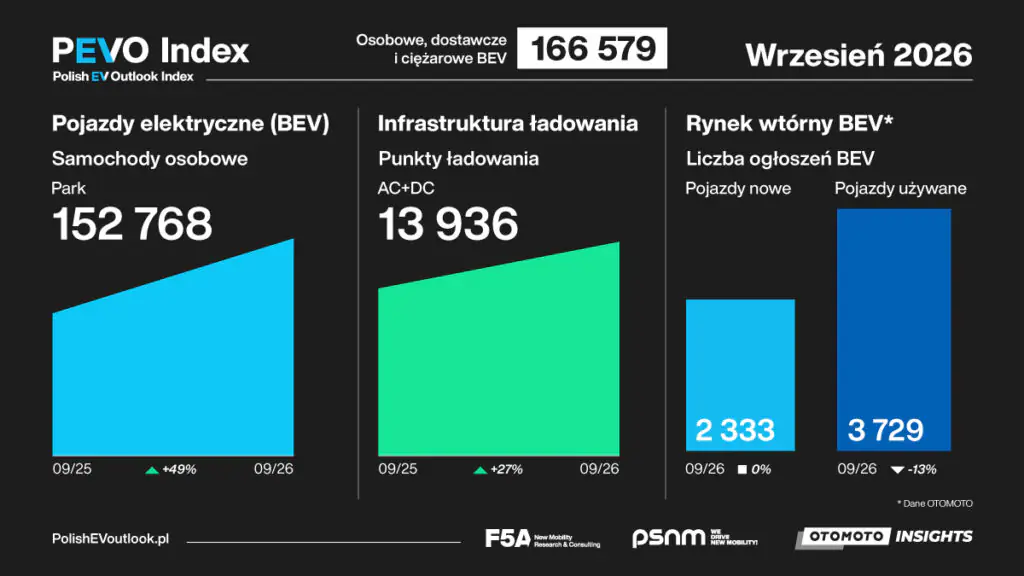
The authors highlight a paradox: Poland wants to manufacture the cars of the future, but its own consumers are still not buying them in significant numbers. In September 2026, fully electric vehicles accounted for just 6.1% of new registrations, while sales fell by nearly 22% year on year following the end of subsidies under the NaszEauto programme. In terms of the share of electric vehicles in new car sales, Poland ranks among the lowest in Europe.
KOMPAS 2035 therefore proposes, among other measures, a social leasing scheme for electric cars aimed at lower-income households, with monthly payments of a few hundred złoty; a package of tax incentives for corporate fleets; a programme to install 15,000 charging points in cities and residential areas; and simpler procedures for installing chargers in multi-unit residential buildings. The aim is to increase the share of electric cars in new vehicle sales to 17% in 2028 and 22% in 2029.
Poland’s Place in Europe Is at Stake
The strategy’s authors argue that the transformation of the automotive industry is now an economic and strategic issue, not merely a climate-related one. It concerns supply chain security, technological independence and hundreds of thousands of jobs. Failure to act would mean declining investment and GDP, an outflow of engineers abroad and the gradual relegation of Poland to lower tiers of the global value chain.
“KOMPAS 2035 clearly shows that the future of Poland’s automotive industry cannot be measured solely by the number of vehicles manufactured in the country. The sector’s strength depends on the entire value chain — parts and component manufacturers, their engineering expertise, proprietary technologies, brands, research and development activities, and their ability to compete in European and global markets.
From SDCM’s perspective, it is therefore essential that the transition increases the value added retained in Poland, rather than merely replacing one type of imported technology with another. Industrial policy, including local content measures, should strengthen the European and domestic supplier base, particularly SMEs, family-owned businesses and companies with domestic capital.
At the same time, we cannot reduce the transition to a change in powertrains alone. It also encompasses digitalisation, new business models, supply chain resilience and the circular economy. Poland has tangible strengths in these areas: a strong automotive parts manufacturing sector, a developed independent automotive aftermarket, domestic brands and expertise in professional parts remanufacturing. These are not relics of the past, but potential sources of competitive advantage in the new automotive landscape.
The key question is whether Polish companies will secure positions in those parts of the value chain where the highest-value technologies, expertise and jobs will be created in the years ahead,” says Tomasz Bęben, President of the Association of Automotive Parts Distributors and Manufacturers (SDCM).
As a result, the coming decade will be decisive in determining Poland’s position in the European and global automotive industry.
KOMPAS 2035 in Figures
– 8% of GDP – the automotive industry’s share of the Polish economy
– 194,000 – people employed in vehicle and parts manufacturing (target: 300,000)
– PLN 105 billion – the sector’s annual exports (target: PLN 150 billion)
– 611,000 – vehicles manufactured in 2024 (target: 1 million annually, 90% of which are to be zero-emission vehicles)
– –
About KOMPAS 2035
KOMPAS 2035 – Strategy for the Transformation of the Automotive Industry is a document prepared by the MotoryzacjaPL coalition, initiated by the Polish New Mobility Association (PSNM), the Polish Automotive Group (PGM), the Association of Automotive Parts Distributors and Manufacturers (SDCM), Silesia Automotive & Advanced Manufacturing, and the Katowice Special Economic Zone. The following ministries were invited to participate in the work, among others: Development and Technology; Energy; Climate and Environment; Finance; Infrastructure; State Assets; Science and Higher Education; and National Education. Other participants included the National Fund for Environmental Protection and Water Management (NFOŚiGW), the General Directorate for National Roads and Motorways (GDDKiA), the Polish Agency for Enterprise Development (PARP), the National Centre for Research and Development (NCBR), the Office of Technical Inspection (UDT), the Transport Technical Supervision Authority (TDT), and the Łukasiewicz Research Network. The strategy’s name is an acronym representing its pillars: Competitiveness, Regulatory Environment, Industrial Modernisation, Production and Supply Chains, Alternative Fuels and the Mobility of the Future, and Technological Sovereignty.
About PSNM
The Polish New Mobility Association (PSNM) is Poland’s largest industry organisation dedicated to developing the electric mobility and alternative fuels markets. It brings together nearly 300 companies from across the electric mobility value chain, including vehicle and infrastructure manufacturers, charging service operators, fuel and energy companies, financial institutions, transport companies, advanced technology suppliers, and other entities and institutions active in sustainable transport. PSNM is a member of E-Mobility Europe, Europe’s largest organisation dedicated to developing the electric mobility market.
About SDCM
The Association of Automotive Parts Distributors and Manufacturers (SDCM) brings together companies operating in the Polish automotive market that specialise in the manufacture and distribution of parts and the provision of related services. It advocates freedom of competition and freedom of choice for consumers and businesses. Through its membership in leading European automotive industry organisations — CLEPA and FIGIEFA — it has a tangible influence on legislative decisions. SDCM’s vision is to ensure that the automotive industry and market operate within the best possible legal framework for businesses, while safeguarding their competitiveness.
About PGM
The Polish Automotive Group (PGM) is an association of Polish manufacturers of parts and components for the automotive industry in the broadest sense. It operates nationwide, and membership is open exclusively to companies with majority Polish ownership. PGM aims to create conditions conducive to the growth of Polish automotive industry businesses. The association also coordinates a cluster bearing the same name. Since 2019, the Polish Automotive Group cluster has held the status of a National Key Cluster, awarded by the Ministry of Development to only the highest-performing cluster organisations with a significant impact on the Polish economy.
About KSSE
The Katowice Special Economic Zone (KSSE) is one of the largest and most important special economic zones in Poland. Established in 1996, it covers the Silesian Voivodeship and parts of the Opole, Lesser Poland and Łódź Voivodeships. Its primary objectives are to attract foreign and domestic investment, support regional economic development, and create new jobs. KSSE regularly ranks among the top performers in international rankings, including those published by fDi Intelligence / the Financial Times.
About SA&AM
Silesia Automotive & Advanced Manufacturing is an initiative established within KSSE that brings together companies and research and development institutions operating in the automotive industry and advanced manufacturing technologies. The cluster aims to foster cooperation between businesses, universities and research institutions, promote innovation, and enhance the competitiveness of companies operating in the sector.