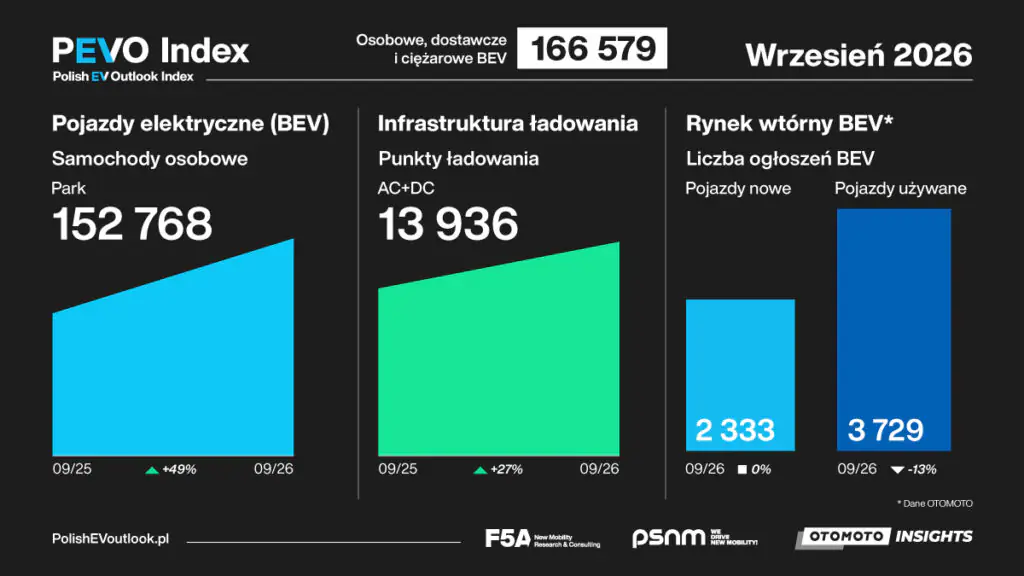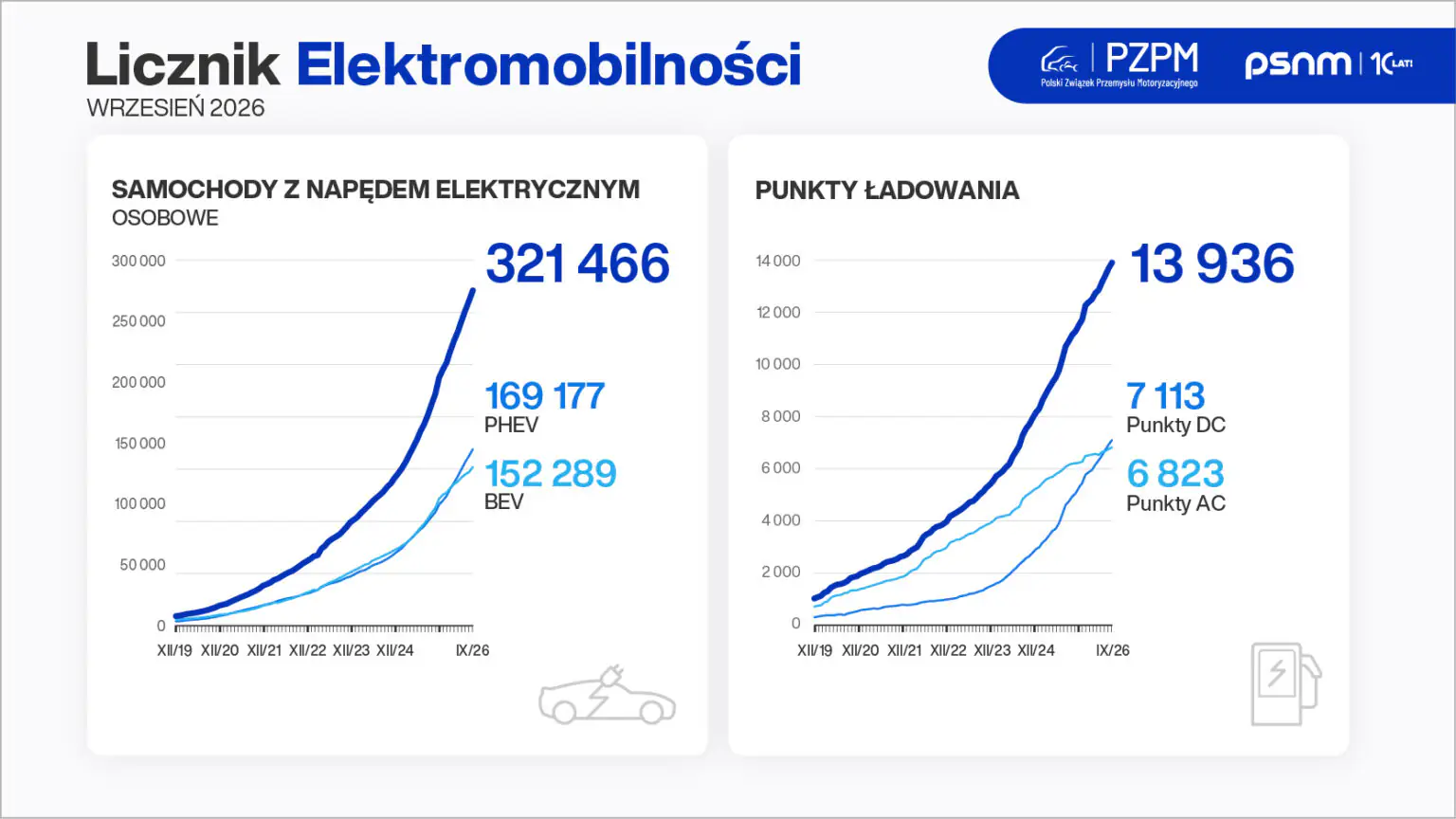
According to data from the end of September 2026, a total of 166,057 all-electric passenger cars and commercial vehicles (BEVs) were registered in Poland. During the first nine months of this year, their number increased by 34,286, approximately 6% more than in the same period of 2025, according to the Electromobility Counter launched by the Polish Automotive Industry Association (PZPM) and the Polish New Mobility Association (PSNM).
At the end of September 2026, there were 321,466 electric passenger cars on Polish roads. The fleet of fully electric passenger cars (BEVs, or battery electric vehicles) totalled 152,289, while the plug-in hybrid fleet (PHEVs, or plug-in hybrid electric vehicles) numbered 169,177. The number of electric light commercial and heavy-duty vehicles stood at 15,016. The fleet of electric mopeds and motorcycles continued to grow, reaching 33,437 at the end of September this year. The number of hybrid passenger cars and light commercial vehicles also increased, rising to 1,539,656. At the end of last month, Poland’s fleet of zero-emission buses grew to 2,949, including 2,715 fully electric vehicles and 234 hydrogen-powered vehicles.
Alongside the growth in the electric vehicle fleet, charging infrastructure is also expanding. At the end of September 2026, Poland had 13,936 publicly accessible electric vehicle charging points. Of these, 51% (7,113) were fast direct current (DC) charging points, while 49% were alternating current (AC) points with a power output of 22 kW or less. At 21% of DC charging points, users can also opt for AC charging.
“By the end of September this year, more than 166,000 battery-electric vehicles across all categories were on Polish roads, representing an increase of nearly 50% compared with the figures for the end of September last year. A significant proportion of these vehicles are new and were purchased thanks to the NaszEauto subsidy programme, which led to a particularly large number of registrations of battery-electric passenger cars around the turn of 2025 and 2026.
“Plug-in hybrid registrations are also performing very well, despite the lack of any support programme — a point I have emphasised repeatedly. In short, there are now roughly as many plug-in hybrid passenger cars on our roads as battery-electric passenger cars. It is also worth noting a 12% increase in registrations of conventional hybrids, whose fleet has reached 1,539,656 vehicles.
“We recorded a substantial increase of nearly 70% in the light commercial and heavy-duty vehicle segment, although this result is clearly driven by registrations of light commercial vehicles. I would like to reiterate my hope that, following the launch of a support programme for heavy-duty vehicle purchases — which has just taken place — registrations of vehicles weighing more than 16 tonnes will rise significantly. Motorcycle and moped registrations are also performing very well, with growth of 50%,” says Jakub Faryś, President of PZPM.
“During the first three quarters of this year, 2,210 publicly accessible charging points were added in Poland, approximately 12% fewer than in the same period last year. However, we are seeing a clear increase in the number of newly installed charging points at locations along major travel routes. From January to September 2026, 514 new charging points were commissioned along Polish sections of the TEN-T network, more than 90% above the figure for the first nine months of last year. Charging stations for electric heavy-duty vehicles are now operating at nine locations,” says Jan Wiśniewski, Director of the PSNM Research and Analysis Centre.